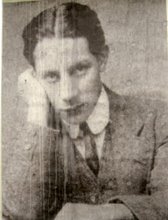
“Kisses”
(Madness before death: with commentary notes)
Note: All poems for this book were selected (or chosen with careful review) in August of 2007, except for “Kisses,” chosen, and added to this selection in, October, of 2008 for its extraordinary content, intensity, and external effects.
English Version
Kisses
By Juan Parra del Riego
Translated and Edited by Dr. Dennis L. Siluk
And Rosa Peñaloza de Siluk (10-11-2008)
Sounds of doves kissing under the moon
you have left in my mouth.
Honeycombs with delirious and wild happiness
you have left in my mouth.
Red and pure hearts of children
you have left in my mouth.
Fields with its happiness of goats and bells
you have left in my mouth.
Your dreadful and blue paleness like my death
you have left in my mouth.
Notes: this extraordinary work (poem) “Kisses” chronicles the ensuing death march; he, Juan Perra was slowly undergoing, and may have been written prior to his last breaths. Much of his poetry was written the last year of his life (1925), and it clearly radiates out in this poem, “Kisses.”
In “Kisses” Juan Perra takes us through some painful moments, his increasingly strained body, and mind, devastatingly brings us into its madness itself. The reader is drawn into his intensity, that his insanity becomes completely real and even rational, as if going to a good movie. He writes—unknowing perhaps, the tragedy of life—the pure truth, if not for some (and surely for me), the happiness and madness in life itself, without pretense, before death. He talks to life itself, as if it was his mistress.
Spanish Version
Besos
Por Juan Parra del Riego
Sonidos de palomas besándose a la luna
me has dejado en la boca.
Panales de alegría delirante y salvaje
me has dejado en la boca.
Corazones de niños colorados y puros
me has dejado en la boca.
Campo con su alegría de chivos y campanas
me has dejado en la boca.
Tu palidez terrible y azul como mi muerte
me has dejado en la boca.
Showing posts with label Juan Parra del Riego. Show all posts
Showing posts with label Juan Parra del Riego. Show all posts
Monday, October 13, 2008

Saturday, July 28, 2007
Biography of "Juan Parra del Riego," in English and Spanish by Dennis L. Siluk

 ENGLISH VERSION
JUAN PARRA DEL RIEGO´S BIOGRAPHY
Juan Parra del Riego was born on December 20, 1894 in the city of Huancayo, Peru; his parents were Domingo Parra Aubilá and Mercedes Rodríguez Gonzáles del Riego. Juan passed his childhood in Arequipa, studied at the College of the “American Independence,” then with his family he moved to Cuzco (Peru), where he took up studies at the National College of Sciences and Art in the city.
At this time, in the city of Cuzco at the college the poet to be, was awaken to his calling, and quickly demonstrated his skill not only in poetry but in football, which he would write about competently in future years.
Juan then moved to Lima with his family, where he lived his vocation, poetry, by pursuing the art and craft of verse writing; and at the early age of nineteen-years old was awarded his first Gold Medal at the First Floral Games organized by the Counsel
District of San Jose de Surco with his poem called, “Canto to Barranco.”
His poetry was published in many of Peru’s newspapers, and while visiting Trujillo, he became friends with Cesar Vallejo.
In 1916 at only 22- years of age, he made a trip in search of the “American and Universal Citizenship,” visiting Chile where he met Gabriela Mistral, then he visited Argentina and Uruguay, where he was nourished with the era’s literary movements.
During this time he embarked on a trip to Europe, traveling across Holland, Spain and France, into Paris, which dazzled him.
During most of these years, and travels his health remained marginal to manageable to intense.
In 1925 he met the lady poet Blanca Luz Brum with whom he married and had a son whom he named Eduardo.
Juan’s health became very fragile but had a transmittable desire for living as one can see by reading many of his poems. In a short period of time his lungs gave out, damaged beyond repair, he was then taken to the Military Hospital in Montevideo, where on November 21, 1925 he died. The president of the Republic of the Uruguay, Jose Serrato, decreed a national holiday and set the Uruguayan flag at half mast. He was buried in the Cemetery of Buceo.
Note: information extracted from literature by Apolinario Mayta Inga, and Klim Kafra, all parts reedited by Dennis L. Siluk, and revised; translated from the Spanish to English and back into the Spanish by Rosa de Peñaloza de Siluk; as it has been prepared for a forth coming book. The portrait are: Juan Parra del Riego's brothers Domingo and Manuel.
SPANISH VERSION
BIOGRAFÍA DE JUAN PARRA DEL RIEGO
Juan Parra del Riego nació el 20 de diciembre de 1894 en la ciudad de Huancayo, Perú; sus padres fueron don Domingo Parra Aubilá y doña Mercedes Rodríguez Gonzáles del Riego. Juan pasó su niñez en Arequipa, estudió en el Colegio “Independencia Americana”, luego con toda su familia se trasladó a Cuzco (Perú), donde estudió en el Colegio Nacional Colegio Nacional de Ciencias y Arte en esa ciudad.
En este tiempo, en la ciudad de Cuzco y en ese colegio el que iba a ser un poeta, fue despertando a ese llamado, y rápidamente demostraba su habilidad no sólo en la poesía sino en el fútbol, del que él escribiría competentemente en años futuros.
Juan se trasladó a Lima con su familia, donde vivió su vocación: la poesía, perseverando en el arte y oficio de los versos escritos; y a la temprana edad de diecinueve años fue premiado con su primera Medalla de Oro en los Primeros Juegos Florales organizado por el Concejo Distrital de San José de Surco con su poema llamado, “Canto a Barranco”.
Sus poesías fueron publicadas en muchos periódicos de Perú, y mientras visitaba Trujillo entabló amistad con César Vallejo.
En 1916 con tan sólo veintidós años de edad, hizo un viaje en busca de la “Ciudadanía Americana y Universal” visitando Chile donde conoció a Gabriela Mistral, luego visitó Argentina y Uruguay, donde fue nutrido con el movimiento literario de esa época.
Durante este tiempo él se embarcó en un viaje a Europa, viajando a través de Holanda, España y Francia, dentro París, ciudad que lo deslumbra.
Durante la mayor parte de estos años, y viajes su salud permanecía marginal e iba deteriorándose.
En 1925 Juan conoció a la poetisa Blanca Luz Brum con quien contrajo matrimonio y tuvieron un hijo al que llamó Eduardo.
La salud de Juan se volvió muy frágil pero el tenía un deseo contagioso por vivir como uno puede ver leyendo sus muchos poemas. En corto tiempo sus pulmones se deterioraron, dañados al punto de no tener cura; él fue llevado al Hospital Militar en Montevideo, donde el 21 de noviembre de 1925 murió. El Presidente de la República de Uruguay, José Serrato, decretó duelo nacional y ordenó izar la bandera uruguaya a media asta. Fue enterrado en el Cementerio de Buceo.
Nota: información extraída de la literatura de Apolinario Mayta Inga y Klim Kafra, todo reeditado y revisado por Dennis L. Siluk; traducido del español al inglés y del inglés al español por Rosa Peñaloza de Siluk; como este ha sido preparado para un próximo libro. Los retratos son de los hermanos de Juan Parra del Riego: Domingo y Manuel.
Subscribe to:
Posts (Atom)